
A limited budget doesn’t need to limit your marketing impact.
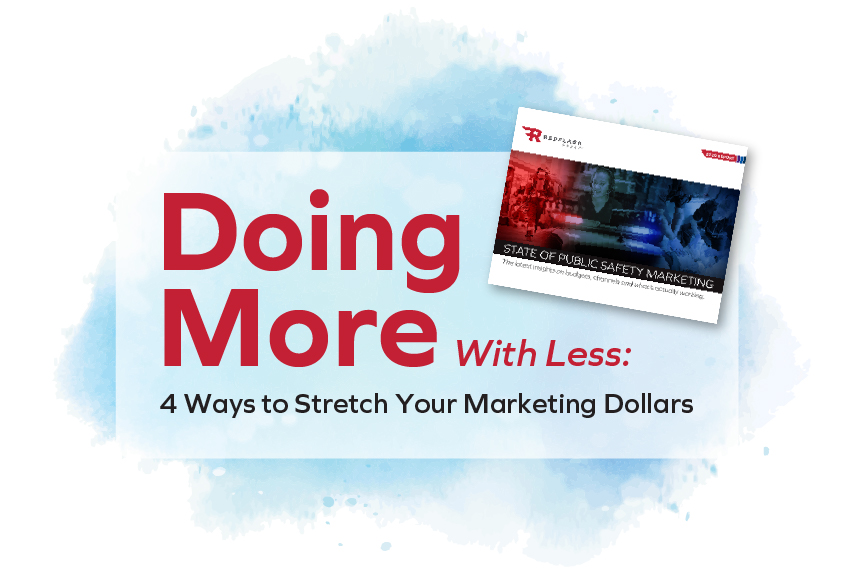
We’re thrilled to share that the Redflash Group “State of Public Safety Marketing: 2026 Report” is out!
There were plenty of interesting findings from this year’s survey, starting with the funding challenges marketing leaders are facing: While more than 60% of marketing leaders said their budget grew (whether a little or a lot), they also said limited funds and other resources remain a big hurdle.
Respondents were honest in sharing, too, that their marketing efforts are often only “somewhat effective.”
Put another way, many feel that there’s simply not enough gas in the tank to get where they want to go. Our recommendation: Have a good cry, realize you’re not alone, and move on, because there’s still a lot you can do, often by wringing out even more from what you’re already spending (or have spent) and allotting a small amount to try something new.
- Leverage conferences to the hilt. In both years of our survey, respondents told us that conferences and trade shows remain super-effective tactics for them. But we bet there’s even more you could be doing, such as getting video and audio testimonials from customers, running a poll from your booth and sharing the results on social media at the end of the show, and capturing case studies (even brief ones) from happy customers who are also attending.
Use these on your website, in email blasts and on social.
- Put a toe into the sponsorship pool. You don’t need to go big on a sponsorship with a public safety media or association partner. A newsletter ad or banner ad on their site can be a great start and a way to drive people to one of those compelling case studies or a relevant past or upcoming webinar.
There’s no need to commit to sponsoring a monthly newsletter for a year; start with one or two months, assess how they perform, and consider testing across multiple partners to see what the best value is for you. You’ll be amazed at how much that media/association partner will do for you once you become their customer/supporter.
- Travel back in time. Tap into your trove of past content—webinars, video or audio interviews, blog posts, thought leadership pieces, white papers, and beyond—and put AI to work transcribing and organizing this archive. You can also pull in content you didn’t create but participated in, such as interviews or keynotes you or your leadership gave or panels you sat on.
Once you’ve carefully reviewed the content to ensure everything is accurate (a lot of content is more timeless than you might think), parse the transcription to identify themes and messages that align with your strategy for reaching customers and prospects. Then use that content across social media, ad campaigns or other tactical outreach.
- Say something meaningful. Putting out a press release is great—if you have something worthwhile to say (tip: this typically doesn’t include the announcement of a new customer or hire).
Share information that’s educational and valuable to the audiences of national and state media and associations; they’ll be much more likely to pick it up. This could be remarkable data, such as how your technology improved response times for your customers by 18% over the past 12 months, or a powerful story of how your product was used to save someone in a devastating disaster or other event.
It’s worth mentioning that a limited budget typically means managing the expectations of your leadership, making clear, for example, that if you have 10 priorities, perhaps six will be possible with the money you have. These can be tough conversations to have, no question about it, but it’s important to be proactive in aligning expectations. We’ve all seen CEOs who decrease the marketing budget but expect home runs all around.
The most important effort most marketers should undertake, regardless of the size of their budget, is this: Prioritize thoughtfully. This comes through very clearly in our 2026 Report Ebook.
You may choose tactics that have the best ROI and minimal or no direct (advertising, paid social, etc.) cost. Or it could mean critically assessing what you’ve been doing for ages that may not be working anymore. Maybe that conference you’ve always attended is continuing to shrink and your best prospects aren’t attending anymore. You might need to look hard at the human-capital cost, whether internal or external, of what you’re doing, including the time and effort it takes to, say, develop ads, as well as deploy, optimize and analyze a campaign.
Analysis is all-important. Why? Many respondents to our survey told us that measuring ROI also remains an issue for them. Often, this is linked to a smaller budget: A marketing team feels like they need more resources to be successful, but they struggle to make a case to leadership for those resources because they can’t demonstrate impact (ROI). It can be a vicious cycle, but it’s also one that can be broken.
Especially in leaner budget years and the current climate of rising prices, triaging what’s important and impactful is critical. But so is leaving behind what isn’t working, leveraging all your assets, and saving a little to try something new.
Check out the “State of Public Safety Marketing: 2026 Report,” and if you’re ready to start a conversation about how to do more with your marketing budget, we’d love to schedule a conversation.
Related Posts
-
It’s easy in tough economies to want to bypass strategy and go straight to tactics.…
-

We’ve all been there. You work for months on a marketing campaign, only to deploy…
-

We’re hoping your holiday season is full of good food, good people and good cheer.…