
How important are the following to your marketing efforts?
Building brand awareness and reputation.
Educating the market about your products/services.
Generating leads.
Being a thought leader in your industry.
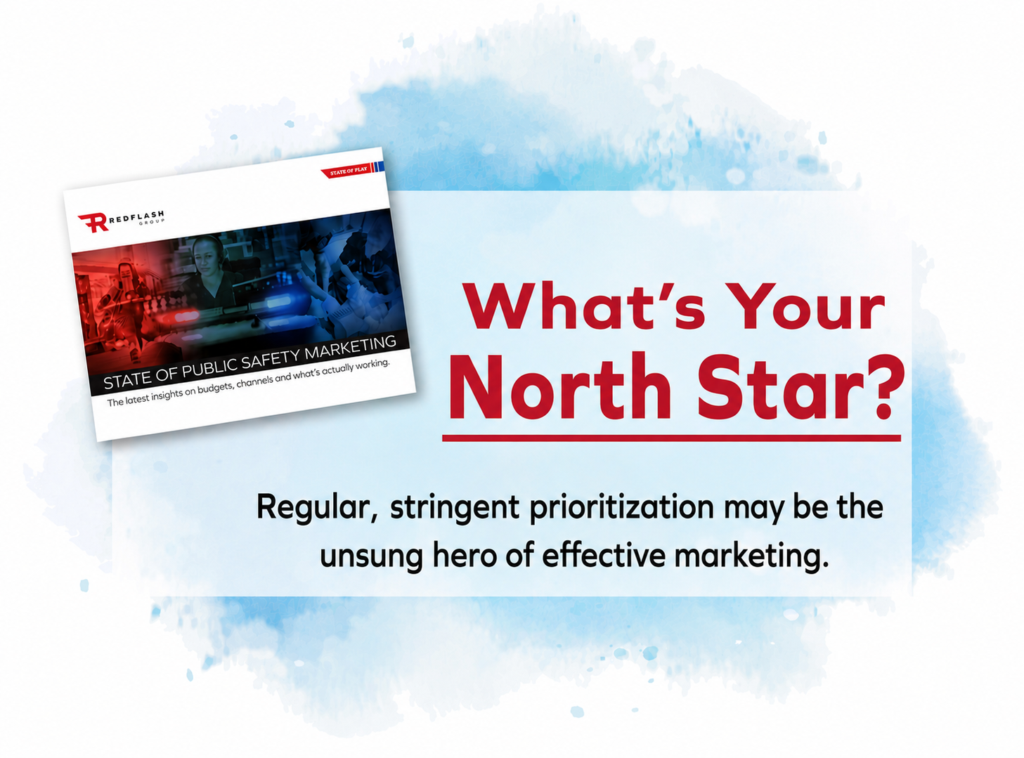
If you said “all of the above,” you’re in good company. So did most of the respondents to our “State of Public Safety Marketing: 2026 Report.” While you shouldn’t feel bad about wanting to hit all the marketing marks, the truth is that if everything is a priority, nothing is.
The fallout of an everything-plus-the-kitchen-sink approach can be significant. Repeat offenders include channel sprawl, aka spreading your marketing tactics too thinly across multiple platforms. Also, team burnout, meaning your staff can’t keep up with every outlet so quality suffers and data fatigue sets in from trying to measure it all. Campaign overload contributes to burnout, but it can also dilute messaging and brand identity. Sometimes you’re doing so much that you’re not even able to evaluate incoming conversions to determine if the prospects you’re getting are those you’re trying to reach.
How to create a strategic marketing focus
The first step to prioritizing what’s truly important is making sure that any marketing strategy connects directly to your organization’s business strategies. Sounds obvious. But you’re probably no stranger to requests (or mandates) that, um, distract you from this focus. Maybe a Board member or CEO likes YouTube videos, but there’s no link to your strategic goals, or you decide to be all in on AI, so you put your focus there (we’re pro-AI, for the record, but we also know that good relationships are critical and irreplaceable in public safety). As much as possible, resist the shiny object unless it aligns with what you’ve defined organizationally as really meaningful.
To help you triage, there’s no end of prioritization frameworks, from the Eisenhower “Do, Decide, Delegate, Delete” matrix (we provided a downloadable worksheet with this matrix in a previous blog post) to the Impact-Effort matrix, which assesses potential impact against how much work it will take to accomplish a task or project. Even simply choosing three priorities is worthwhile.
We suggest adding your most important goal(s) to the top of the whiteboard as you’re brainstorming and refining (it’s surprisingly easy to forget that North Star!). It might be that you want to expand your customer base into three key states. Or your existing clients typically don’t buy your full product suite, so you’ll know you’re successful when you’ve increased the additional products they purchase. Maybe your customer retention numbers need a kick in the pants. Start with those goals, then figure out what’s realistic for marketing to help to achieve them.
For the example of expanding your customer base in specific areas, you might focus on regions where you already have “lighthouse” clients and market to 911 centers, law enforcement, EMS agencies and/or fire departments in surrounding areas rather than taking a wider (and potentially scattershot) approach. Include in your priorities a range of tactics. Maybe that’s email targeting in those nearby regions via geofencing or working with local and regional public safety associations. If elevating your organization’s position as a thought leader is important to you, specific activities could include launching a LinkedIn campaign; submitting for speaking engagements at key events; regularly publishing blogs, white papers and/or videos; or joining a national or regional committee.
(Remember that foundational elements should always be part of your strategy and tactics. These table stakes include a robust LinkedIn presence for your brand, Google ads, some advertising in industry media, and a presence at conferences that are meaningful to your company. To use a firefighting term, a “surround and drown” approach can serve you well when you’re trying to expand to new states or regions (as in the previous example), but in other cases you could be better off focusing on those fundamentals, at least to start. Measure how these are performing even as you weigh up adding other tactics to achieve key priorities.)
The role of data and analysis
Part of triaging what’s most strategically important to you requires looking at what you have been doing. Is it working—or not so much? Again, sounds obvious. Too often, though, true analysis either doesn’t happen or doesn’t happen often or deeply enough. To make matters worse, marketers responding to our 2024 and 2026 surveys admitted they often repeat their marketing plan from year to year, even if it’s not as impactful as they’d like.
Using data to determine which marketing activities you can get rid of will, of course, free up time and budget for new efforts. Some priorities, such as conferences and trade shows, require planning in one- or even two-year cycles, and you’ll also likely need to consider the fiscal budget cycles that rule the worlds of law enforcement, EMS, the fire service, and 911. But don’t wait 12 months to assess results! We recommend allowing at least three months before evaluating how a LinkedIn branding campaign is working, for example, then optimizing what you’re doing or switching gears, if necessary. For trade shows, your team may still be seeing leads come in six months later, and they can tweak Google ads often to improve keyword performance.
Speaking of staff, we strongly recommend including your team in decision-making about which strategies and tactics you’ll prioritize. Not involving them in this process misses an opportunity not only to build a sense of shared ownership in what you need to achieve together but to get their ideas in the mix. What’s more, honest internal discussions can also help clarify what you’re really good at as a team, as well as what you’re not as strong in.
You may be killing it at trade shows, for instance, but building thought leadership, something you struggle with, is now a priority. Similarly, it could be that you register for the same trade show year after year, but the ROI just isn’t there anymore. It’s worth talking through whether you need to be there or if that time and money could go to a new priority. Many marketing leaders tell us they need more resources to be successful, especially when it comes to content creation, lead generation, and building brand awareness, and filling those gaps may mean looking for outside expertise.
It can be scary to try something new—and you may miss the mark, that’s true—but if you’re flying blind or doing the marketing version of rinse-and-repeat, it’s a lot harder to achieve those North Star priorities. But if you triage thoughtfully, regularly measure what’s working and what’s not, and honestly assess strengths and weaknesses as you go, the benefits of prioritization will be visible and impactful.
Check out the “State of Public Safety Marketing: 2026 Report,” and if you’re ready to talk about how to create compelling case studies, we’d love to schedule a conversation.
Related Posts
-

Redflash Group recently released the 2026 edition of our “State of Public Safety Marketing” report,…
-

A limited budget doesn’t need to limit your marketing impact. We’re thrilled to share that…
-

10 ways to step up your conference game Trade shows and conferences are a significant…